
Kalkaska County Bankruptcy Records
Kalkaska County bankruptcy cases are handled by the U.S. Bankruptcy Court for the Western District of Michigan. The primary courthouse is in Grand Rapids, with the Traverse City area serving as a satellite access point for some northern Michigan hearings. PACER and the free VCIS phone line let residents search records without traveling to Grand Rapids.
Kalkaska County Overview
Western District Bankruptcy Court for Kalkaska County
All Kalkaska County bankruptcy cases go to the U.S. Bankruptcy Court for the Western District of Michigan. Kalkaska County is a rural county in the northern Lower Peninsula, bordered by Grand Traverse County to the west and Antrim County to the north. The village of Kalkaska serves as the county seat. The drive from Kalkaska to the Grand Rapids courthouse is roughly 160 miles south via US-131.
The primary filing location for all Kalkaska County cases is One Division Avenue, North, Room 200, Grand Rapids, MI 49503. The Western District also maintains satellite court access in the Traverse City area, and some hearings for northern Michigan counties may be scheduled there rather than in Grand Rapids. When you file a case, ask the Grand Rapids clerk where your hearings will be held. All records, dockets, and administrative matters are managed at Grand Rapids.
The clerk's office phone is (616) 456-2693 and email is MIWB_CaseInfo@miwb.uscourts.gov. Hours are Monday through Friday, 8:00 am to 4:00 pm. The court website at miwb.uscourts.gov has forms, local rules, and fee information for Kalkaska County filers.
| Court | U.S. Bankruptcy Court, Western District of Michigan - Grand Rapids Division |
|---|---|
| Address | One Division Avenue, North, Room 200 Grand Rapids, MI 49503 |
| Phone | (616) 456-2693 |
| Fax | (616) 456-2919 |
| Hours | Monday through Friday, 8:00 AM to 4:00 PM |
| MIWB_CaseInfo@miwb.uscourts.gov | |
| Website | miwb.uscourts.gov |
| County Clerk | 605 N Birch St, Kalkaska, MI 49646 | (231) 258-3300 |
How to Search Kalkaska County Bankruptcy Records
Given the distance from Kalkaska to Grand Rapids, remote access through PACER or VCIS is the most practical option for most residents. PACER is the federal courts' online records system. Register free at pacer.uscourts.gov. Log in and select the Western District of Michigan. Search by debtor name, case number, or the last four digits of a Social Security number. PACER returns the full case docket with every document filed, available at any hour from any internet connection.
Each page you view or download costs $0.10, with a $3.00 cap per document. Quarterly charges under $30.00 are waived automatically. Most searches end up costing nothing at all. The Western District case information page explains how to navigate PACER for this specific court.
VCIS at 866-222-8029 is free and runs 24 hours a day. The automated system reads back basic case data: case number, chapter type, filing date, trustee name, and whether the case is open or closed. No account or registration needed. This is the right first call when you just need to confirm whether a bankruptcy case exists for a specific person.
For in-person access, the Grand Rapids courthouse has free public terminals in the clerk's area. Printing costs $0.10 per page. Staff can help with complex searches and explain the copy request process. From Kalkaska, mailing a copy request to the clerk's office may be more practical than making the long drive. Include the case number, the documents you need, and payment. The Western District also accepts copy requests by fax or email with a Copy Request Form.
Note: Older cases filed before electronic records were in use may be in off-site storage and can take several weeks to retrieve. Contact the clerk before you travel if you need records from a case filed decades ago.
What Kalkaska County Bankruptcy Records Contain
Every Kalkaska County bankruptcy case file follows the same federal structure used in courts across the country. The petition opens the case and triggers the automatic stay, which stops most collection actions immediately. The schedules come with the petition. They list every piece of real and personal property the debtor owns, every debt owed, and monthly income and expenses. These are public records from the day the case is filed.
The statement of financial affairs covers the debtor's financial history for the two years before filing. It asks about income, large payments to creditors, property transfers, and lawsuits. In Kalkaska County, where some residents have rural land, timber rights, or oil and gas interests, the schedules can reflect more varied asset types than in urban counties. The trustee examines all of this to understand the full financial picture.
As the case proceeds, creditors file proofs of claim, the trustee reports to the court, and orders accumulate in the docket. Chapter 13 cases include a repayment plan confirmed by the court. All plan modifications are public record. The discharge order is the final document in a successful case, confirming that certain debts were legally eliminated. Anyone can access the complete docket through PACER or at the Grand Rapids courthouse.
Filing Fees and Record Access Costs
Federal law sets bankruptcy filing fees uniformly across the Western District. Chapter 7 costs $338 to file. Chapter 13 costs $313. These are the same for all counties in the district, including Kalkaska. No additional local fees apply. Fees are paid to the clerk of court at the time of filing. The court accepts money orders, personal checks with some restrictions, and credit or debit cards.
If paying the full fee at once is a hardship, apply for an installment plan with your petition. The court may approve up to four payments, all due before the case closes. Chapter 7 filers with income at or below 150% of the federal poverty guideline can apply for a full fee waiver using Form 103B. Fee waivers are not available for Chapter 13 cases.
Copies from the clerk cost $0.50 per page for plain copies and $12.00 plus $0.50 per page for certified copies. PACER downloads are $0.10 per page with a $3.00 cap per document. PACER downloads are not certified. The Western District accepts copy requests by mail, fax, or email with a Copy Request Form. Full details are at miwb.uscourts.gov/obtaining-copies-documents.
Michigan Bankruptcy Exemptions for Kalkaska County Filers
Michigan requires all bankruptcy filers to use state exemptions under MCL 600.5451. Michigan has opted out of the federal exemption system, so federal exemptions are not available. Every Kalkaska County filer must use state law to determine what property is protected.
The homestead exemption protects up to $46,125 of equity in a primary residence. For filers who are 65 or older, disabled, or a qualifying surviving spouse, the limit is $69,200. In Kalkaska County, where homes in rural and forested areas often carry moderate values, the exemption frequently covers the full equity. That means many Chapter 7 filers in the county can keep their homes. If equity exceeds the cap, Chapter 13 may be a better fit.
Other Michigan exemptions protect one vehicle up to $3,725, household goods up to $600 per item, work tools up to $2,800, and most retirement accounts. MCL 600.6023 adds protection for wages, disability income, and certain insurance proceeds. Kalkaska County residents with rural land or natural resource rights should review those assets carefully with a bankruptcy attorney before filing to ensure all applicable exemptions are claimed.
Note: Michigan exemption amounts are adjusted periodically. Confirm current limits with an attorney or the court before filing.
Local Resources for Kalkaska County Filers
The Kalkaska County Clerk at 605 N Birch St, Kalkaska, MI 49646, phone (231) 258-3300, holds state court records and does not maintain federal bankruptcy records. For state civil judgments, liens, and local court filings in Kalkaska County, the county clerk is the right contact.
Legal Aid of Western Michigan serves northern Michigan counties including Kalkaska. The Michigan Legal Help site at michiganlegalhelp.org has free guides on bankruptcy and finding legal help. The State Bar of Michigan's lawyer referral service can connect you with a licensed bankruptcy attorney in the Traverse City or Grand Rapids area who handles Western District cases. Several attorneys in Traverse City take cases from Kalkaska and neighboring counties.
Kalkaska County public libraries provide free computer access for PACER searches. PACER account setup is free. Most routine lookups cost nothing under the quarterly fee waiver threshold. If you need help getting started, library staff and the court's public information line can assist.
Western District Court Information
The Western District of Michigan Bankruptcy Court at miwb.uscourts.gov provides all forms, local rules, and filing guides for Kalkaska County cases, including information on Traverse City satellite access for northern Michigan filers.
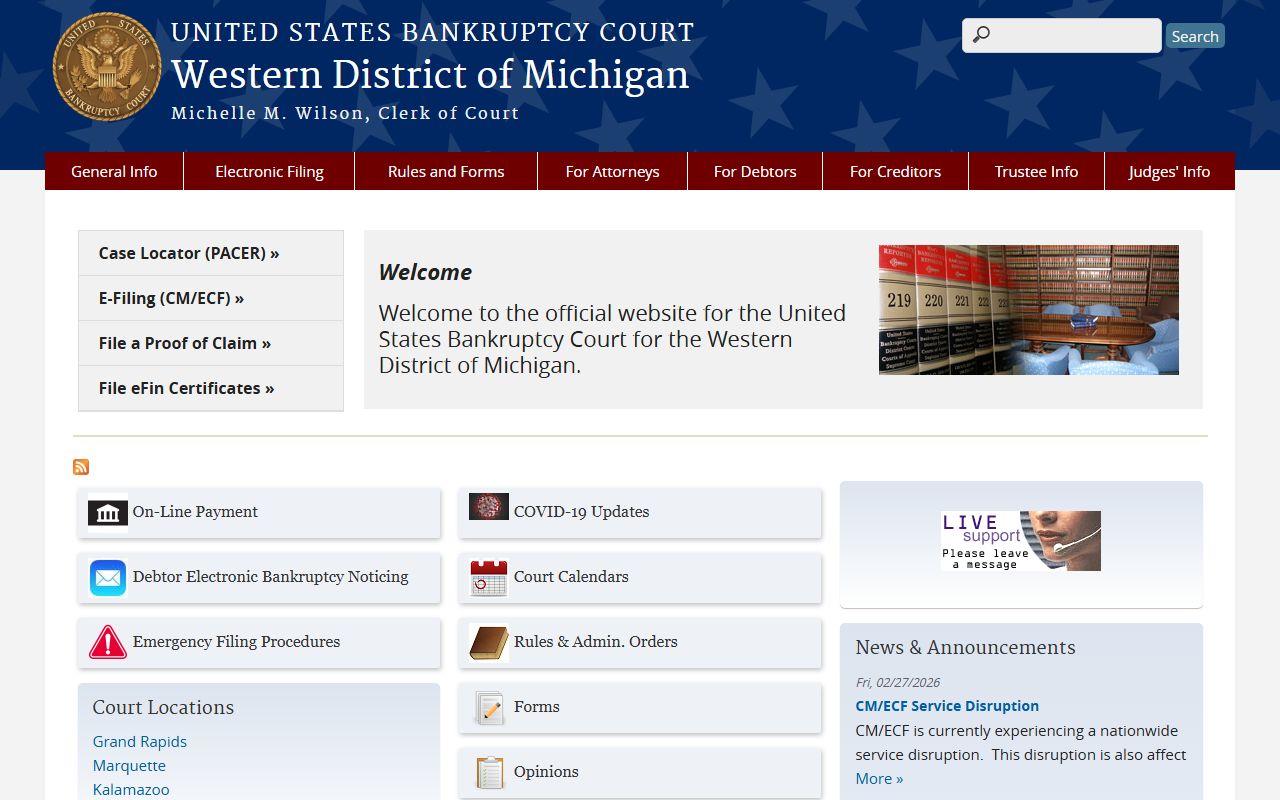
Kalkaska County residents can use the court website to find required forms, learn about fee waiver options, and review local rules before filing a bankruptcy case.
Nearby Counties
These counties are near Kalkaska County in northern Michigan. All file bankruptcy cases through the Western District of Michigan.